How to Calculate Your BMR at Home: A Complete Beginner Guide

Introduction
You do not need a laboratory, a clinic visit, or an expensive device to know your basal metabolic rate. You need a bathroom scale, a tape measure, four numbers, and about ten minutes. This guide walks you through calculating your BMR at home, from measuring yourself properly to turning the result into a daily calorie figure you can actually eat to, with the checks that tell you whether the figure is working.
If you want the arithmetic in full, our step by step guide to calculating BMR covers the equation term by term with worked examples. This guide is the practical companion: the home measurement routine, the activity decision, the two week test, and what to do when the number does not match what your body is doing.
Before you calculate: measure weight and height properly
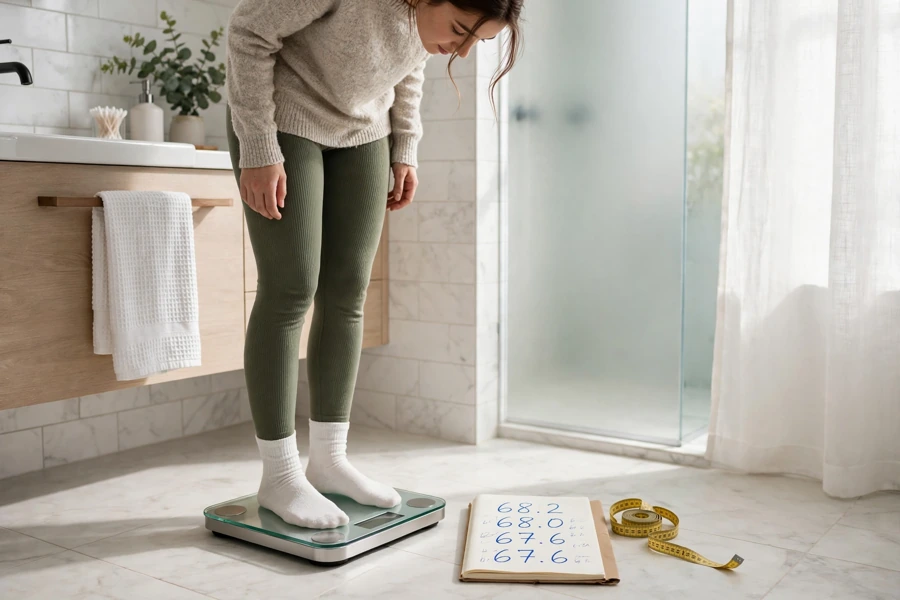
A BMR calculation is only as good as its inputs, and weight is the input that moves the result most. Weigh yourself first thing in the morning, after using the bathroom, before eating or drinking, in light clothing or none, on a hard floor, not carpet, which can throw a scale off by kilograms. Use the same scale, in the same spot, at the same time of day. A single weighing is noisy: weight fluctuates by a kilogram or more day to day with water, food in transit, and glycogen, so take a morning weight for three to seven days and use the average. That average, not yesterday's outlier, is the weight to enter.
Height is simpler but still worth doing properly. Stand barefoot against a wall, heels together, back straight, looking ahead, and mark the top of your head with a book held level, then measure from floor to mark. Many adults overestimate their height by a centimetre or two from memory, and every centimetre is worth 6.25 calories in the equation, so a 3 centimetre error is about 19 calories, small but avoidable. If you know your height from a recent medical measurement, use that instead of a home estimate.
Age is your age at your last birthday, and sex is the value the equation uses, with different constants for men and women reflecting average body composition differences. The equation was validated on adults, so it is not for children or teenagers, whose energy needs include growth. If you are pregnant, have a thyroid disorder, or have another condition that affects metabolism, treat any home calculation as a rough starting point only, and get a personal figure from a clinician.
Run the calculation, in plain steps
Convert to kilograms and centimetres first if you measured in pounds and inches: divide pounds by 2.205, multiply inches by 2.54. Then apply the Mifflin-St Jeor equation. For men: 10 times weight in kilograms, plus 6.25 times height in centimetres, minus 5 times age, plus 5. For women: the same, minus 161 instead of plus 5. A 30 year old woman weighing 65 kilograms at 170 centimetres gets 650 plus 1,062.5 minus 150 minus 161, which is 1,401.5, about 1,402 calories per day at rest. The free BMR Calculator on this site performs this in one click, and it is worth running your hand calculation through it as a cross-check: if the two disagree, you have a unit or arithmetic error, not a mystery.
Write the result down with its date and the weight you used. BMR is not a number to memorise once, it is a record to revisit: when your weight changes by about 5 kilograms, recalculate. Keeping a dated note, for example BMR 1,402 on 5 November at 65 kilograms, makes later changes interpretable instead of confusing. It also stops the common habit of recalculating daily from fluctuating scale weights, which adds noise and anxiety for no benefit.
Turn BMR into daily calories you can eat to
Multiply BMR by an activity factor to get total daily energy expenditure, TDEE, your maintenance calories. Use 1.2 if you are sedentary, a desk job with little or no exercise; 1.375 if lightly active, light exercise one to three days a week; 1.55 if moderately active, moderate exercise three to five days a week; 1.725 if very active, hard exercise six to seven days a week; and 1.9 if extra active, a physical job or twice-daily training. Our example woman at a BMR of 1,402 needs about 1,682 calories sedentary, 1,928 lightly active, 2,173 moderately active, 2,419 very active, and 2,664 extra active.
Be honest, and when in doubt, round down. Most people overestimate their activity, because they remember the workout and forget the ten sedentary hours around it. A useful reality check is a step count: under 5,000 steps a day is sedentary whatever the gym habit, 5,000 to 7,500 is lightly active, 7,500 to 10,000 is moderately active, and over 10,000 with regular training is very active. If you do not track steps, ask what your job and commute actually involve: sitting all day with a car commute is sedentary even with three gym sessions a week, while a job on your feet all day is active even without a gym.
Once you have TDEE, set your goal. For maintenance, eat at TDEE. For weight loss, eat about 300 to 500 calories below TDEE, not below BMR, for a loss of roughly a quarter to half a kilogram a week, which most people can sustain. For weight gain, eat about 300 to 500 above TDEE, with protein and resistance training so the gain is mostly muscle. Our Calorie Calculator builds these targets from the same Mifflin-St Jeor base, so the two tools agree, and you can use it to see maintenance, loss, and gain targets side by side.
The two week test: does your BMR figure work
No equation knows your body, so test the figure. Eat at your calculated maintenance level for two weeks, as consistently as you can, and weigh yourself each morning under the same conditions, then compare weekly averages, not single days. If your average weight is stable within a few hundred grams, your TDEE estimate is right. If it falls steadily, your true TDEE is higher than calculated, so add 100 to 200 calories and test again. If it rises steadily, your true TDEE is lower, so subtract 100 to 200 calories. Two weeks is the minimum for a meaningful test: one week is dominated by water shifts, especially if you changed salt, carbohydrate, or exercise at the same time.
During the test, keep the rest of life as steady as you can. A new exercise programme, a holiday, illness, or a large change in carbohydrate intake all move water weight and confuse the signal. That does not mean you must live identically for a fortnight, only that you should interpret a jump in the first few days with suspicion and trust the trend across the second week more than the first. If your weight moves by more than a kilogram in a week in either direction, something besides fat change is happening, usually water, and the calorie adjustment should wait until the trend settles.
When your BMR result looks wrong
If your calculated BMR seems impossibly low, check the units first: pounds entered as kilograms is the classic error, and it inflates rather than deflates, so a low figure more often comes from centimetres entered as inches, or from the female constant used for a man, which subtracts 166 calories. If it seems impossibly high, check for pounds as kilograms, the male constant used for a woman, or a weight that includes heavy clothing or a scale on carpet. Recompute from scratch, slowly, rather than tweaking the result until it looks plausible: a calculation adjusted to feel right is no longer a calculation.
If the arithmetic is right but the two week test disagrees by more than 300 calories, consider body composition. A very muscular person will burn more than the weight-based estimate, and a person with very low muscle mass will burn less. In that case a lean-mass formula may help, but only with a trustworthy body fat measurement, and our BMR formula guide explains the trade-offs. Also consider medication, thyroid status, and recent large weight loss, which can temporarily suppress metabolic rate below the predicted figure as the body adapts. Persistent large discrepancies deserve a clinician's input, not a bigger spreadsheet.
Tools, trackers, and wearables: helpful or misleading
Fitness watches and apps estimate calorie burn from heart rate, movement, and their own equations, and they are useful for trends but unreliable for absolute calories, often off by 20 percent or more for an individual day. Use them to compare this week with last week, not to set your eating target to the calorie: if your watch says you burned 3,200 calories but your weight is stable at 2,400 eaten, trust the scale, not the watch. The same applies to gym machines, which routinely overstate exercise calories, and to food tracking apps, whose database entries vary in accuracy.
The most reliable home toolkit is boring: a scale, a tape measure, a consistent morning weigh-in, and a simple food log for the test period. You do not need to log food forever, but logging for the two week test removes the biggest confounder, which is eating a different amount than you think. Most people underestimate intake by 20 percent or more when they guess, and a test eaten at a guessed intake tests nothing. Log honestly for two weeks, learn your true maintenance, and then you can relax the logging, because you will know what maintenance looks like on your plate.
Special cases: age, activity change, and plateaus
BMR falls slowly with age, about 5 calories a year in the equation's age term, but the larger age effect in real life comes from muscle loss and reduced activity, both of which are partly preventable with resistance training and daily movement. An older adult who trains retains a higher metabolic rate than the equation alone might suggest, which is another reason to test with the weight trend rather than accept the figure blindly. Conversely, a young adult who sits all day may have a lower true expenditure than their age suggests, because the activity factor, not the age term, dominates.
When your activity changes for a sustained period, recalculate TDEE, not just BMR: starting a physical job, beginning marathon training, or moving from a desk to a standing role can shift daily needs by hundreds of calories, while BMR itself barely moves. When weight loss stalls, first check adherence and activity before blaming metabolism: a plateau of two weeks is normal, water and glycogen mask fat loss, and a plateau of four weeks at a genuine deficit deserves a recalculation at the new weight, which will be lower, and possibly a diet break rather than a deeper cut. Cutting further on a stalled, already low intake is the fastest route to fatigue and rebound.
What to do after the two week test
Once the two week test gives you a confirmed maintenance figure, write it down as your personal TDEE, with the weight and activity pattern it belongs to, because that figure is more valuable than any calculator output: it is measured on you, in your life, at your current activity. From there, adjustments are small and evidence based. If you want to lose weight, subtract 300 to 500 calories from that confirmed figure, not from a fresh calculator estimate. If you want to gain, add 300 to 500. If your activity changes, adjust the figure by the change in daily movement, roughly 100 calories per 2,000 extra steps a day, and test again for a week before trusting the new number.
Revisit the figure whenever life changes in a sustained way: a new job, a new training programme, a move that changes your commute, or a weight change of about 5 kilograms. Between those milestones, leave it alone. The most common failure mode after a successful test is not a wrong figure, it is constant tinkering, recalculating after every daily fluctuation and chasing noise. A confirmed maintenance figure, held steady for a month, teaches you more about your eating than any sequence of recalculations, because it lets you learn what maintenance actually looks like on a plate, in your routine, week after week.
Frequently asked questions
Can I calculate BMR at home without special equipment?
Yes. You need a bathroom scale, a tape measure, and the Mifflin-St Jeor equation. No lab visit or metabolic cart is required for a useful estimate.
Why should I average my weight over several days?
Daily weight fluctuates by a kilogram or more with water, food, and glycogen. A three to seven day morning average removes that noise and gives the weight the equation should use.
How do I pick the right activity factor?
Judge your whole day, not just workouts. A desk job with three gym sessions is moderately active at most. Step counts help: under 5,000 a day is sedentary, over 10,000 with training is very active.
How long before I know if my BMR figure is right?
About two weeks at a consistent intake, comparing weekly average weights. One week is too noisy, because water shifts dominate.
What if my fitness watch disagrees with my calculation?
Trust the scale over two weeks, not the watch on one day. Wearables are good for trends but often off by 20 percent or more on absolute calories.
When should I recalculate BMR?
When your weight changes by about 5 kilograms, or your sustained activity pattern changes, such as a new physical job or a training programme. Not daily.
The Bottom Line
Your BMR at home is a measured weight, a measured height, one equation, an honest activity factor, and a two week test. Skip any one of those and the number is a guess; do all five and it is a tool you can plan meals, training, and weight goals around with confidence.
Try it free on SeoRivon Tools
Put this guide to use with these free tools: